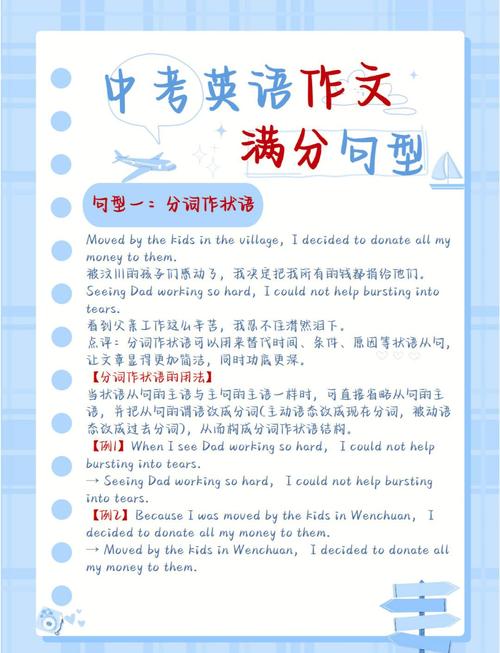
在英文写作中,无论是学术 essays、考试作文还是日常应用文,掌握一些通用句型都能显著提升文章的逻辑性、连贯性和表达准确性,这些句型不仅适用于不同主题和体裁,还能帮助 writers 更清晰地阐述观点、过渡段落或总结全文,以下将从开头、主体、结尾及过渡四个部分,系统整理实用的英文作文通用句型,并结合具体场景说明其用法。
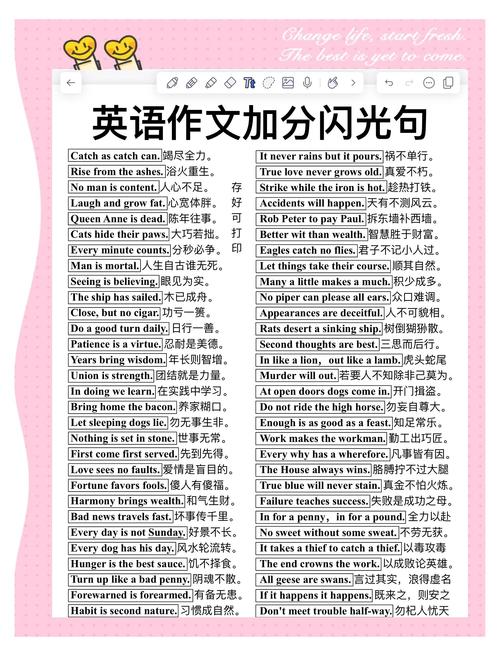
开篇句型:吸引读者,明确主题
开篇段落的核心任务是“凤头”——迅速抓住读者注意力,并点明文章主旨,以下是不同场景下的开篇句型:
现象引入型(适用于社会、科技等话题)
- In contemporary society, [主题] has become an increasingly prominent issue, sparking widespread debate among the public.
(在当代社会,[主题]已成为一个日益突出的问题,引发了公众的广泛讨论。) - Over the past decade, the rapid development of [相关领域] has profoundly transformed the way people [生活/工作方式].
(在过去的十年里,[相关领域]的快速发展彻底改变了人们[生活/工作方式]。)
观点对立型(适用于议论文,引出争议)
- When it comes to [话题], opinions are divided as to whether [观点A] or [观点B] is more beneficial.
(当谈到[话题]时,观点A]和[观点B]哪个更有益,人们意见不一。) - The issue of [主题] has long been a contentious topic, with proponents arguing [支持方观点] while opponents counter [反对方观点].
([主题]长期以来一直是一个有争议的话题,支持者认为[支持方观点],而反对者则反驳[反对方观点]。)
数据/事实型(增强说服力)
- According to a recent survey conducted by [机构], approximately [百分比]% of [人群] believe that [核心观点].
(根据[机构]最近的一项调查,约[百分比]%的[人群]认为[核心观点]。) - Statistics reveal that [具体数据], highlighting the urgent need for [解决方案/讨论].
(数据显示[具体数据],凸显了[解决方案/讨论]的紧迫性。)
主体句型:论证观点,展开细节
主体段落是文章的“猪肚”,需通过论据、例子或分析支撑主题句,以下按“提出观点→举例说明→分析原因”的逻辑整理句型:
提出分论点
- First and foremost, [分论点1] plays a crucial role in [主题相关领域].
([分论点1]在[主题相关领域]中起着至关重要的作用。) - Another significant factor contributing to [主题] is [分论点2], which cannot be overlooked.
(导致[主题]的另一个重要因素是[分论点2],这一点不容忽视。)
举例论证
- A case in point is [具体例子/案例], which demonstrates how [例子支撑的观点].
(一个恰当的例子是[具体例子/案例],它证明了[例子支撑的观点]。) - For instance, [引用数据/研究] shows that [数据结论], further strengthening the argument.
([引用数据/研究]表明[数据结论],进一步强化了该论点。)
分析原因/影响
- The primary reason for [现象] is that [深层原因], which explains why [现象普遍存在].
([现象]的主要原因在于[深层原因],这解释了[现象普遍存在]的原因。) - Such a trend is likely to have profound implications for [ affected领域], ranging from [积极影响] to [消极影响].
(这一趋势可能对[受影响领域]产生深远影响,从[积极影响]到[消极影响]不等。)
对比论证
- While some argue that [观点A], others contend that [观点B]. A closer examination reveals that [更合理的观点].
(虽然一些人认为[观点A],但其他人坚持认为[观点B],仔细审视可以发现[更合理的观点]。) - In contrast to [对比事物], [当前事物] offers distinct advantages, such as [优势1] and [优势2].
(与[对比事物]相比,[当前事物]具有显著优势,优势1]和[优势2]。)
结尾句型:总结全文,升华主题
结尾段落需“豹尾”——简洁有力地总结观点,或提出展望、建议,以下是常用句型:
总结观点型
- In conclusion, all the aforementioned factors underscore the significance of [主题] in [ broader context].
(上述所有因素都凸显了[主题]在[更广泛背景]中的重要性。) - To sum up, while [争议点] remains complex, the evidence suggests that [核心结论] is the most viable approach.
(尽管[争议点]仍然复杂,但证据表明[核心结论]是最可行的方法。)
提出建议/展望
- Therefore, it is imperative that [相关方] take immediate measures to [具体建议], such as [建议措施].
([相关方]必须立即采取行动[具体建议],建议措施]。) - Looking ahead, the future of [主题] will largely depend on [关键因素], calling for greater attention and innovation.
(展望未来,[主题]的前景将很大程度上取决于[关键因素],这需要更多的关注和创新。)
强调重要性
- Ultimately, [主题] is not merely a personal choice but a collective responsibility that shapes [社会/.
([主题]不仅仅是个人的选择,更是一种塑造[社会/的集体责任。) - Only by recognizing the value of [主题] can we unlock its full potential and build a [更美好的目标].
(只有认识到[主题]的价值,我们才能释放其全部潜力,构建[更美好的目标]。)
过渡句型:衔接段落,增强逻辑
过渡句是文章的“润滑剂”,确保段落间衔接自然,以下是按逻辑关系分类的句型:
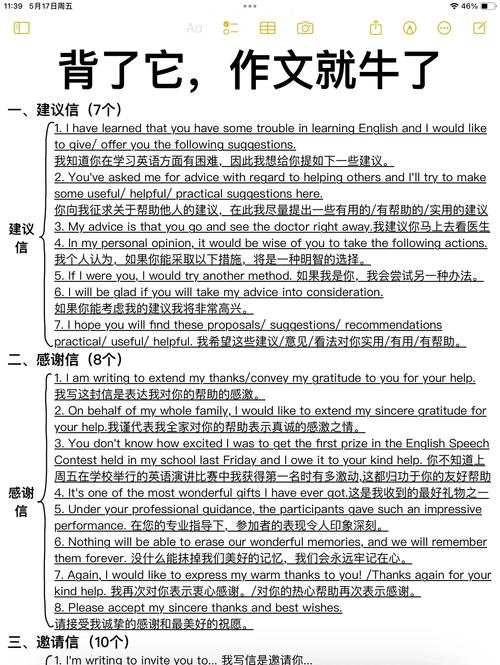
表递进
- Furthermore, [新观点] provides additional support for the main argument.
([新观点]为主论点提供了更多支持。) - Moreover, [补充信息] cannot be ignored when evaluating [主题].
(在评估[主题]时,[补充信息]不容忽视。)
表转折
- However, it is worth noting that [相反观点], which complicates the issue.
(值得注意的是[相反观点],这使得问题复杂化。) - On the contrary, [对立事实] suggests that [新的论证方向].
(相反,[对立事实]表明[新的论证方向]。)
表因果
- As a result, [结果] has become an inevitable consequence of [原因].
([结果]已成为[原因]的必然结果。) - Consequently, [影响] is likely to reshape [相关领域] in the long run.
([影响]可能会在长远意义上重塑[相关领域]。)
表举例
- Specifically, [具体例子] illustrates the practical application of [理论/观点].
([具体例子]说明了[理论/观点]的实际应用。) - Take [例子] as an example: it demonstrates how [例证核心].
(以[例子]为例:它证明了[例证核心]。)
英文作文通用句型速查表
| 功能分类 | 句型示例 |
|---|---|
| 开篇引入 | In contemporary society, [主题] has become an increasingly prominent issue... |
| 提出观点 | First and foremost, [分论点] plays a crucial role in... |
| 举例说明 | A case in point is [例子], which demonstrates how... |
| 分析原因 | The primary reason for [现象] is that [深层原因]... |
| 对比论证 | While some argue that [观点A], others contend that [观点B]... |
| 总结全文 | In conclusion, all the aforementioned factors underscore the significance of... |
| 提出建议 | Therefore, it is imperative that [相关方] take immediate measures to... |
| 过渡递进 | Furthermore, [新观点] provides additional support for... |
FAQs 相关问答
Q1: 如何在英文作文中灵活运用通用句型,避免模板化?
A1: 灵活运用句型的关键在于“理解逻辑而非死记硬背”,明确句型背后的功能(如举例、转折、,根据具体话题替换关键词,而非直接套用完整句子,举例句型“A case in point is...”可替换为具体例子,如“A case in point is Finland’s education system, which demonstrates how equality enhances learning.”结合同义替换(如“important”替换为“crucial/vital”)和句式变化(主动变被动、简单句变复合句),能让表达更自然。
Q2: 通用句型是否适用于所有类型的英文作文(如议论文、说明文、书信)?
A2: 通用句型的核心逻辑(如开篇点题、主体论证、结尾总结)适用于多数作文类型,但需根据体裁调整细节,议论文需强化观点对立和论证句型(如“Proponents argue... while opponents counter...”);说明文侧重现象描述和解释原因(如“The phenomenon can be attributed to...”);书信则需增加礼貌性表达(如“I am writing to express my concern about...”),在掌握通用句型的基础上,需结合具体体裁要求灵活调整,避免生搬硬套。