
口语话题 space
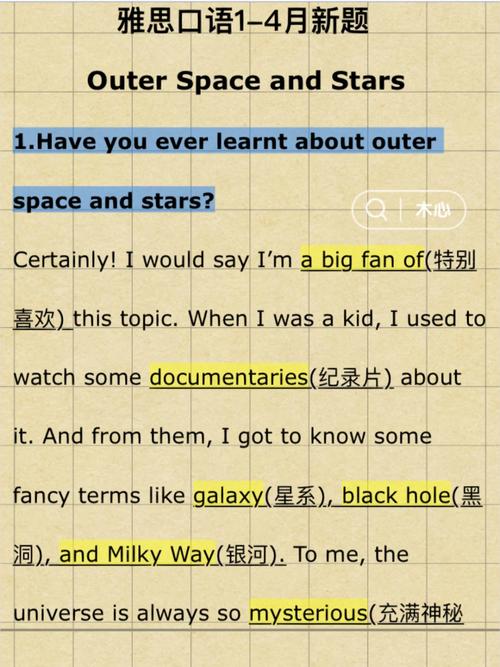
探索宇宙是人类永恒的向往,而“space”作为口语话题,既能激发科学兴趣,又能引发哲学思考,在日常交流中,从太空探索技术到地外生命可能性,从宇宙的奥秘到人类未来的太空移民,“space”相关话题总能带来丰富的讨论,本文将围绕口语话题“space”展开,涵盖其核心议题、讨论方向及实用表达,帮助读者更好地参与相关对话。
太空探索的里程碑与现状
太空探索是人类科技进步的重要标志,从早期的人造卫星到如今的火星任务,每一次突破都成为口语交流中的热点。
历史性成就
1957年,苏联发射第一颗人造卫星“斯普特尼克1号”,开启了太空时代;1969年,美国“阿波罗11号”实现人类首次登月;2025年,中国“天问一号”成功着陆火星,携带“祝融号”火星车开展探测,这些事件不仅是科学壮举,也是口语中“space”话题的经典素材,“Do you know that China's Mars mission landed successfully in 2025? It was a huge milestone!”
当代探索重点
全球太空探索集中在三个方向:深空探测(如火星、木星)、空间站建设(如国际空间站ISS、中国空间站)和商业航天(如SpaceX的星链计划),SpaceX的可回收火箭技术降低了发射成本,使得更多人关注商业航天的未来:“SpaceX's reusable rockets have changed the game. Do you think commercial space travel will be affordable for普通人 in the future?”
太空探索的意义
太空探索不仅推动科技进步(如卫星通信、气象预测),还促进国际合作(如国际空间站的多国协作),甚至启发人类对地球的思考:“Looking at Earth from space makes us realize how fragile our planet is.”
地外生命与宇宙奥秘
地外生命是否存在?宇宙中还有多少未解之谜?这些问题为“space”话题增添了神秘色彩,也是口语讨论中的趣味切入点。
地外生命的可能性
科学家通过探测火星地下冰层、木卫二和土卫二的海洋,以及分析系外行星的宜居带,不断寻找生命存在的证据。“The discovery of water on Mars makes me wonder: could there be microbial life there?” “费米悖论”(如果外星文明存在,为何我们尚未发现)也是热门讨论点:“Why haven't we made contact with aliens? Maybe they're too far away, or we're not looking hard enough.”
宇宙的未解之谜
暗物质、暗能量、黑洞、宇宙起源等话题充满哲学意味。“Dark matter makes up about 27% of the universe, but we still don't know what it is. It's so mysterious!” 在口语中,可以用对比或提问引发思考:“The universe is expanding, but what's it expanding into?”
科学与哲学的碰撞
太空探索常引发对人类定位的思考:“Are we alone in the universe? If we find aliens, how would that change our view of ourselves?” 这类问题没有标准答案,却能激发深度交流。
太空技术与日常生活
尽管太空探索看似遥远,但其技术成果早已融入日常生活,成为“space”话题中贴近现实的讨论点。
太空技术的民用转化
GPS导航、气象卫星、医疗设备(如MRI技术源于太空成像)等,都源于太空技术。“Did you know that your phone's GPS works because of satellites? Space tech is everywhere!” 太空材料科学(如隔热材料)也被用于日常用品,如运动鞋和服装。
商业航天的未来
SpaceX、蓝色起源等公司推动太空旅游发展,未来普通人或许能体验亚轨道飞行或太空酒店。“Imagine booking a trip to space for your vacation! Would you go if you could afford it?” 讨论时,可结合成本、安全性等角度:“Space tourism is still expensive, but maybe in 20 years, it'll be as common as flying abroad.”
太空资源开发
小行星采矿、月球基地建设等设想,可能解决地球资源短缺问题。“Mining asteroids for rare metals could reduce the need to dig on Earth. What do you think about this idea?”
太空移民与人类未来
随着地球环境问题加剧,太空移民成为科幻与现实交织的话题,引发对人类未来的畅想。
火星移民的挑战
火星表面辐射强、大气稀薄、温度极低,需解决生命支持、食物生产等问题。“Living on Mars would require growing food in greenhouses and wearing spacesuits all the time. Is it worth it?” 伦理问题也备受关注:“Should we spend billions on Mars colonies when there are problems on Earth?”
太空社会的构建
若人类在太空建立永久定居点,如何管理社会?“Would a Mars colony have its own government, or would it be controlled by Earth?” 这类问题可延伸至文化、法律等话题,激发创意讨论。
对人类的启示
太空移民提醒人类珍惜地球:“Before we colonize other planets, we need to take care of our own. Earth is our only home for now.”
口语表达与讨论技巧
围绕“space”话题,掌握实用表达能让交流更流畅,以下是常用词汇和句型:
核心词汇
- 太空探索:space exploration, deep-space probe, Mars rover
- 地外生命:extraterrestrial life, alien civilization, microbial life
- 太空技术:reusable rocket, satellite navigation, space station
- 宇宙奥秘:dark matter, black hole, the Big Bang
实用句型
- 表达观点:“I believe space exploration is crucial for human progress.”
- 提出疑问:“Do you think we'll find life on Mars in our lifetime?”
- 举例说明:“For instance, the Hubble Telescope has captured amazing images of distant galaxies.”
讨论方向
- 科技与伦理:“Is it ethical to spend money on space when there's poverty on Earth?”
- 个人兴趣:“What aspect of space fascinates you the most—planets, black holes, or something else?”
相关问答FAQs
Q1: 如何用简单英语向孩子解释“太空探索”?
A1: 可以用比喻和日常例子:“Space exploration is like sending detectives to the universe. We send robots and satellites to planets (like Mars) to learn more about them—what they're made of, if there's water, or even if little creatures live there! It's like solving a big space puzzle!”
Q2: 普通人如何参与太空话题的讨论?
A2: 不需要专业知识,只需关注基础事实和表达观点:
- 从新闻入手:“Did you hear about the latest moon mission? Several countries are planning to build bases there.”
- 分享个人感受:“I find space fascinating because it makes me feel small but also part of something huge.”
- 提开放性问题:“If you could visit any planet, which one would you choose and why?”
我们围绕“space”话题,从科技、哲学、生活等多个维度展开讨论,既提供了知识储备,也分享了口语表达技巧,无论是日常闲聊还是深度交流,“space”都能激发好奇心与思考,成为连接不同观点的桥梁。