掌握雅思写作的精髓,不仅在于词汇的丰富与语法的准确,更在于能否清晰、有逻辑且有力地表达观点,一套行之有效的句式模板,如同建筑中的坚固框架,能帮助考生快速构建文章结构,稳定输出高质量内容,本文将深入探讨如何运用经典句式提升写作水平,并融入对写作逻辑与语言地道性的思考。
(图片来源网络,侵删)
开篇引言:精准破题,确立基调
文章开头是给考官的第一印象,需直接、清晰且富有吸引力,避免冗长铺垫,应迅速切入主题。
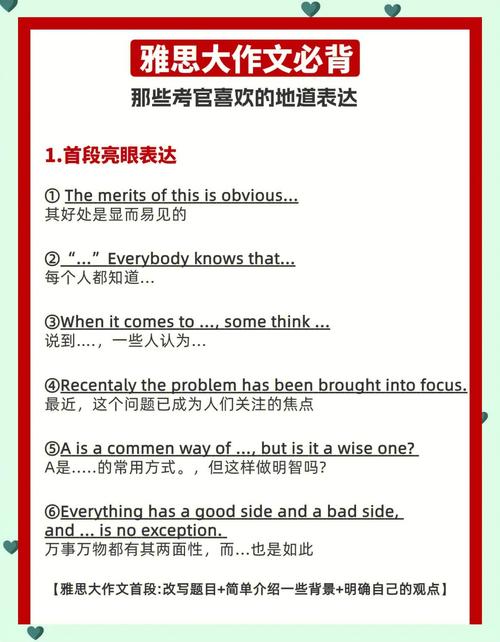
- 现象描述法:在当代社会,[某个普遍现象或趋势] 已成为一个备受关注的话题。“In contemporary society, the widespread use of social media has become a topic of intense debate.”
- 观点对比法:讨论主题],人们的观点常常迥异,一些人坚信……,而另一些人则持相反意见,句式:“Opinions are deeply divided regarding [topic]. While some people are convinced that…, others maintain an opposing view.”
- 问题引入法:随着[某个背景发展],[相关问题] 日益凸显,这引发我们思考:[提出核心问题]。“With the accelerating process of globalization, the issue of cultural identity has come to the fore. This leads us to ponder: how can traditions be preserved in a modern world?”
开篇段落需明确给出自己的立场或文章将要探讨的方向,为后续论证铺平道路。
主体段落:逻辑推进,论证充分

(图片来源网络,侵删)
主体段是文章核心,每个段落应围绕一个中心论点展开,遵循“主题句 → 解释 → 例证 → 分析”的基本逻辑链。
-
提出论点:
- 首要且最直接的论点是…… “The primary and most straightforward argument is that…”
- 不容忽视的一点在于…… “What cannot be overlooked is that…”
- 这主要归因于以下两个因素。 “This can be primarily attributed to two factors.”
-
进行解释与阐述:
- 这意味着…… “This implies that…”
- …… “Put simply, …”
- 更具体地考察,我们会发现…… “A closer examination reveals that…”
-
列举例证:
- 以……为例,便是明证。 “A case in point is…”
- 这一观点在……的例子中得到了充分体现。 “This viewpoint is well illustrated by the example of…”
- 历史/统计数据提供了有力支持。 “Historical evidence/Statistical data offers compelling support for this.”
-
对比与让步:
- 诚然,有人会主张…… “Admittedly, it might be argued that…”
- 尽管……有其优点,但其弊端更为显著。 “While the benefits of… are acknowledged, its drawbacks are more pronounced.”
- 与……形成鲜明对比的是…… “In stark contrast to…, …”
-
分析结果与影响:
- 这不可避免地会导致…… “Consequently, this would inevitably lead to…”
- 从长远来看,其影响可能是深远的。 “In the long term, the implications could be profound.”
- 这不仅关乎……,更会影响…… “This matters not only for…, but also for…”
结尾段落:重申升华,留下余韵
结尾应有力总结,重申核心立场,并可能提出建议或展望,避免简单重复开头。
- 总结观点法:综合考虑上述讨论,可以得出结论:…… “Taking all arguments into consideration, it can be concluded that…”
- 强调重要性法:认识到……的重要性至关重要。 “Therefore, it is crucial to recognize the significance of…”
- 展望建议法:展望未来,[采取某种措施] 将是明智之举,唯有如此,我们才能…… “Looking ahead, it would be prudent to… Only in this way can we…”
超越模板:实现个性化与地道表达
模板句式是工具而非枷锁,真正的高分作文需要在熟练运用基础上,展现语言灵活性与思想深度。
- 同义替换:避免重复使用“important”,可替换为“crucial”, “vital”, “significant”, “paramount”,将“think”替换为“maintain”, “believe”, “argue”, “contend”。
- 连接词多样化:除了“firstly, secondly”,可使用“to begin with”, “moreover”, “furthermore”, “additionally”表示递进;使用“however”, “nevertheless”, “on the other hand”表示转折;使用“for instance”, “such as”, “to illustrate”进行举例。
- 语法结构丰富性:交替使用简单句、复合句和复杂句,恰当运用非谓语动词短语、插入语、同位语从句、条件状语从句等,使句子层次分明,使用“Given that…, …”或“Provided that…, …”来引导条件。
- 语境与语气:根据讨论话题的严肃性调整语言风格,学术讨论需正式客观,避免过度口语化或情绪化词汇。
在备考过程中,建议考生建立自己的句式库,通过大量阅读范文和官方材料,积累地道表达,更重要的是,坚持动笔练习,将模板内化为自己的语言本能,针对不同题目灵活调整内容,确保论证具体、贴切,而非空泛套用。
优秀的雅思作文是清晰思维与熟练语言能力的共同产物,框架确保文章结构稳健,而真正填充其中的、有说服力的观点和例证,才是获得考官青睐的关键,通过持续积累与针对性练习,每位考生都能找到属于自己的写作节奏与表达方式,在考场上从容应对,展现最佳水平。