雅思作文替换汇总是提升写作分数的关键环节,很多考生虽然掌握了基础语法和逻辑,却因词汇重复、表达单一而被扣分,雅思写作评分标准中“词汇资源”(Lexical Resource)一项明确要求考生“使用丰富的词汇能力,能灵活使用不常见词汇及搭配”,而替换词的恰当运用正是这一能力的直接体现,以下将从动词、名词、形容词、连接词及高频话题场景五个维度,系统梳理雅思作文中的实用替换词,并辅例句说明用法,帮助考生突破词汇瓶颈。
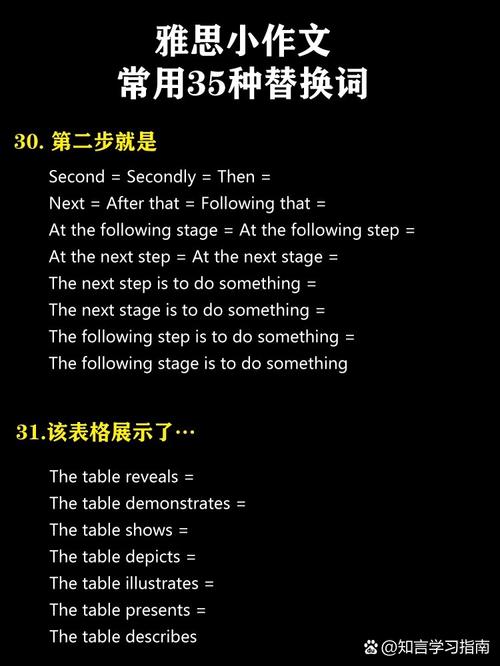
动词替换:避免重复,精准表意
动词是句子的核心,频繁使用同一个动词会显得语言贫乏,根据动作的强度、正式程度及语境差异,可按以下类别替换:
表“增加、上升”
- 基础词:increase
- 替换词:rise, grow, surge, soar, climb, escalate, mount
- 例:The number of online shoppers has soared by 30% in the past year.(比increased更具画面感,强调快速上升)
- Surge多指突然、急剧增长,如Energy demand surged during the heatwave.
表“减少、下降”
- 基础词:decrease
- 替换词:decline, drop, fall, diminish, dwindle, plummet, slump
- 例:The city’s bird population has diminished due to habitat loss.(diminish强调逐渐减少,带有“削弱”意味)
- Plummet指“暴跌”,如House prices plummeted after the financial crisis.
表“解决问题、处理”
- 基础词:solve
- 替换词:tackle, address, resolve, handle, cope with, mitigate
- 例:Governments should tackle traffic congestion by improving public transport.(tackle更强调“着手处理复杂问题”)
- Mitigate常用于减轻负面影响,如Measures to mitigate climate change are urgent.
表“影响、改变”
- 基础词:affect
- 替换词:influence, impact, shape, alter, transform, modify
- 例:Social media shapes teenagers’ perceptions of beauty.(shape强调“塑造”,比affect更有力)
- Transform指“彻底改变”,如The internet transformed the way people communicate.
表“认为、相信”
- 基础词:think, believe
- 替换词:argue, maintain, contend, assert, hold the view that, be convinced that
- 例:Some experts contend that artificial intelligence will replace human workers.(contend带有“争论、坚持主张”的意味,更正式)
名词替换:提升学术性,避免口语化
名词是信息的载体,尤其在议论文中,使用更精准、正式的名词能体现语言功底。
表“问题、困难”
- 基础词:problem
- 替换词:issue, challenge, dilemma, predicament, drawback
- 例:Unemployment is a pressing issue in many European countries.(issue比problem更中性,常用于社会议题)
- Dilemma指“两难困境”,如Students face the dilemma of choosing between work and further study.
表“原因、因素”
- 基础词:reason
- 替换词:cause, factor, determinant, contributor
- 例:Lack of exercise is a major contributor to obesity.(contributor强调“促成因素”,比cause更灵活)
- Determinant指“决定因素”,如Education is a key determinant of future income.
表“方法、方式”
- 基础词:way
- 替换词:approach, method, strategy, tactic, means
- 例:The government adopted a new approach to reduce carbon emissions.(approach强调“思路、方法”,比way更具体)
- Tactic常用于策略,如Companies use various tactics to attract customers.
表“影响、结果”
- 基础词:effect
- 替换词:impact, consequence, outcome, repercussion
- 例:The impact of social media on mental health is widely discussed.(impact比effect更强调“冲击力”)
- Repercussion指“(不良)连锁反应”,如The economic crisis had serious repercussions worldwide.
表“重要性、作用”
- 基础词:importance
- 替换词:significance, crucial role, vital part, paramount importance
- 例:Environmental protection has paramount importance for sustainable development.(paramount importance表示“至关重要”,语气最强)
形容词替换:增强表达层次,避免单调
形容词用于描述事物特征,合理替换能让描述更生动、准确。
表“重要的”
- 基础词:important
- 替换词:vital, crucial, significant, essential, indispensable, paramount
- 例:It is vital to protect children’s online privacy.(vital强调“对生命或成功极其重要”)
- Indispensable表示“不可或缺的”,如Water is indispensable for life.
表“不好的、负面的”
- 基础词:bad
- 替换词:detrimental, harmful, adverse, negative, detrimental, deleterious
- 例:Smoking has detrimental effects on health.(detrimental比harmful更正式,强调“有害的”)
- Deleterious常用于学术语境,如Pollution has a deleterious impact on ecosystems.
表“大量的”
- 基础词:many, much
- 替换词:numerous, a multitude of, a host of, a plethora of, substantial
- 例:A multitude of factors contribute to urbanization.(a multitude of表示“大量”,比numerous更生动)
- Plethora常带贬义,指“过剩”,如There is a plethora of information online, but not all is reliable.
表“明显的、显著的”
- 基础词:obvious
- 替换词:apparent, evident, conspicuous, manifest, pronounced
- 例:The apparent benefits of renewable energy attract investment.(apparent强调“显而易见的”,但暗含“需进一步验证”)
- Pronounced指“显著的、明显的”,如There is a pronounced difference in living standards between urban and rural areas.
连接词替换:优化逻辑衔接,提升流畅度
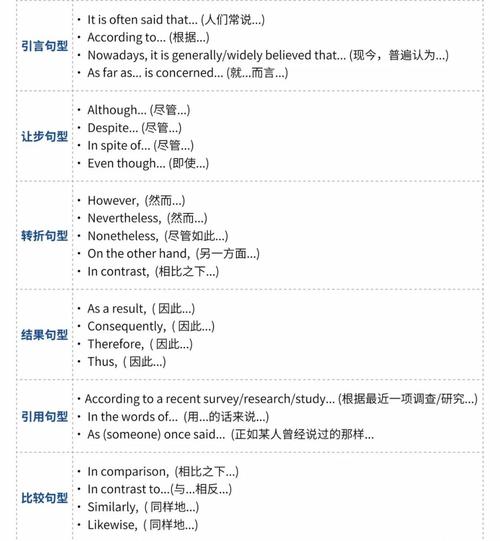
连接词是句子的“润滑剂”,恰当使用能让文章逻辑清晰、过渡自然,根据逻辑关系分类如下:
表“转折”
- 基础词:but
- 替换词:however, nevertheless, nonetheless, conversely, on the contrary, whereas
- 例:The economy is growing; nevertheless, many people still live in poverty.(nevertheless比but更正式,强调“尽管如此”)
- Whereas用于对比,如Some people enjoy urban life, whereas others prefer rural areas.
表“因果”
- 基础词:because
- 替换词:due to, owing to, as a result of, consequently, thus, hence, therefore
- 例:The project was delayed owing to a lack of funding.(owing to比because更正式,常置于句首)
- Consequently表“,强调直接结果,如The company cut costs; consequently, profits increased.
表“递进”
- 基础词:and
- 替换词:furthermore, moreover, in addition, additionally, what’s more, besides
- 例:The new policy will create jobs; furthermore, it will improve the environment.(furthermore强调“进一步补充”)
- What’s more口语化较强,适用于半正式写作,如The restaurant has great food; what’s more, the service is excellent.
表“举例”
- 基础词:for example
- 替换词:for instance, such as, take…as an example, a case in point is
- 例:Many countries, for instance, Sweden, have adopted carbon taxes.(for instance比for example更正式)
- A case in point is…是举例的经典句式,如A case in point is the success of electric vehicles.
高频话题场景替换:针对性提升
雅思作文常涉及教育、科技、环境、社会等话题,掌握这些场景的核心替换词能快速切入主题。
教育类
- “学习”:acquire knowledge, absorb information, cultivate skills, develop expertise
- 例:Universities should focus on helping students cultivate critical thinking skills.
- “教育体系”:educational framework, academic system, schooling approach
- 例:Reforming the educational framework is necessary to meet future needs.
科技类
- “技术进步”:technological advancement, innovation in technology, rapid development of science and technology
- 例:Technological advancement has transformed communication methods.
- “互联网影响”:impact of the internet, influence of online platforms, digital era effects
- 例:The influence of online platforms on social interaction cannot be ignored.
环境类
- “污染”:pollution, environmental degradation, contamination, ecological damage
- 例:Air pollution poses a threat to public health.
- “保护环境”:protect the environment, preserve ecosystems, conserve natural resources, promote sustainability
- 例:We must conserve natural resources for future generations.
社会类
- “老龄化问题”:aging population, demographic shift, increase in the elderly proportion
- 例:The aging population brings challenges to healthcare systems.
- “文化交流”:cultural exchange, cross-cultural interaction, integration of diverse cultures
- 例:Cultural exchange enhances mutual understanding between countries.
常见替换词速查表(精选高频)
| 基础词 | 替换词(3-5个) | 适用场景 |
|---|---|---|
| important | vital, crucial, significant, essential | 议论重要性时 |
| good | beneficial, advantageous, positive | 描述积极影响时 |
| bad | harmful, detrimental, adverse | 描述消极影响时 |
| show | indicate, demonstrate, reveal, illustrate | 展示数据、观点时 |
| help | assist, facilitate, aid, support | 提供帮助、支持时 |
| change | alter, transform, modify, shift | 描述变化、调整时 |
FAQs
雅思写作中替换词是不是越多越好?
并非越多越好,替换词的使用需基于“准确性”和“语境适配性”,盲目堆砌生僻词反而可能导致表达错误或逻辑混乱。“解决”在“solve a math problem”中只能用solve,而“solve environmental issues”则可用tackle或address,建议优先掌握高频词的精准替换,确保在正确语境中使用恰当词汇,而非追求生僻度。
如何有效记忆和运用替换词?
建议分三步:① 分类记忆:按动词、名词、话题场景整理替换词表,结合例句理解用法;② 造句练习:针对每个替换词写3-5个句子,确保掌握其搭配和语境;③ 写作应用:在平时练习中有意识地替换基础词,完成后对照范文对比差异,查漏补缺,写“手机改变生活”时,尝试用“transform”代替“change”,用“revolutionize”代替“greatly change”,逐步形成肌肉记忆。
掌握替换词的核心是“精准”而非“数量”,通过系统梳理和刻意练习,考生能让作文词汇从“正确”升级到“精彩”,从而在雅思写作中脱颖而出。