雅思作文中的投诉信是一种实用性强、格式固定的文体,主要目的是向机构、个人或组织表达不满,要求解决问题或给出合理解释,其核心在于“有理有据、语气得体”,既要清晰传达诉求,又要保持礼貌,避免情绪化表达,以下从投诉信的结构、写作要点、常用句型及实例解析等方面展开详细说明,帮助考生掌握此类作文的写作方法。
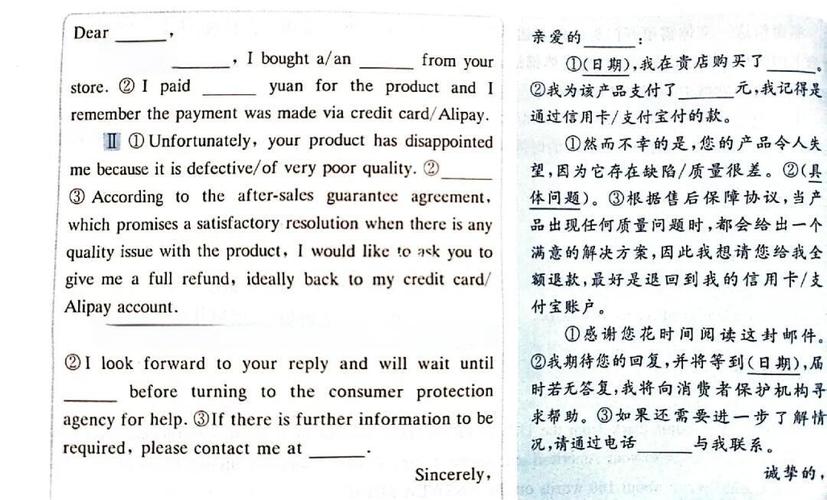
投诉信的基本结构与写作要点
投诉信通常遵循“明确事由—阐述问题—说明影响—提出诉求—期待回复”的逻辑框架,具体可分为六个部分:
称呼(Salutation)
根据收信对象选择合适的称呼,若收信方为机构或不确定具体联系人,常用“Dear Sir/Madam”或“Dear Customer Service Team”;若知晓具体部门或负责人,可写“Dear Manager of [Department]”(如“Dear Manager of the Hotel”),称呼需正式,避免使用非正式称呼如“Hi”。
开篇:自我介绍与写信目的(Introduction)
开篇需简明扼要说明身份(如顾客、用户、消费者等)及写信的核心目的——投诉。“I am writing to express my strong dissatisfaction regarding [具体问题] I experienced on [时间/场合].” 避免冗长铺垫,直接点明主题,让收信方迅速了解信件主旨。
主体段一:详细描述问题(Description of the Problem)
这是投诉信的核心部分,需具体、客观地阐述问题发生的时间、地点、经过及相关细节,需包含以下要素:
- 事件背景:问题发生的具体情境(如购物、旅行、使用服务等)。
- 问题细节:描述问题的具体表现,避免模糊表述(如不说“服务很差”,而说“服务员态度恶劣,对我提出的需求置之不理”)。
- 证据支撑:若有相关证据(如订单号、收据、照片、录音等),可提及以增强可信度(如“I have attached the order number [XXX] and the receipt for your reference”)。
注意:描述时需保持客观,仅陈述事实,不添加主观臆断或情绪化词语(如避免使用“简直是诈骗”“太恶心了”等表述)。
主体段二:说明问题造成的影响(Impact of the Problem)
阐述问题带来的负面影响,如经济损失、时间浪费、精神困扰、安全隐患等,这部分能体现问题的严重性,促使收信方重视。
- 经济影响:“This defect has caused me a financial loss of [金额], as I had to purchase a new one to replace the broken product.”
- 精神影响:“The rude behavior of your staff not only ruined my travel experience but also made me feel disrespected as a customer.”
影响需与问题直接相关,避免夸大或无关的延伸。
主体段三:提出具体诉求(Proposed Solutions/Demands)
清晰列出希望对方采取的措施,诉求需合理、可行,避免过于苛刻或不切实际,常见诉求包括:
- 要求赔偿(经济补偿、退款等):“I request a full refund of [金额] to compensate for the inconvenience.”
- 要求道歉(书面或口头):“I expect a formal apology from your company for the poor service.”
- 要求改进服务或产品:“I suggest that you inspect the quality control of your products to avoid similar issues.”
- 要求调查反馈:“Please investigate this matter and inform me of the result within [具体时间].”
若无法明确具体诉求,可写“I hope you can take immediate action to address this issue and prevent it from happening again.”
期待回复与感谢(Closing)
结尾需表达对收信方处理的期待,并保持礼貌,常用句型:“I look forward to your prompt reply and a satisfactory resolution to this issue. Thank you for your attention to this matter.” 最后使用正式结束语,如“Yours sincerely,”(若知晓收信人姓名)或“Yours faithfully,”(若使用“Dear Sir/Madam”), followed by your full name and contact information(姓名及联系方式)。
投诉信常用句型与表达
开篇表达投诉
- I am writing to complain about...
- I am writing to express my dissatisfaction with...
- I am extremely disappointed with the... I received on...
描述问题细节
- On [日期], I purchased/ordered/experienced... at [地点].
- The problem is that... (具体问题).
- To be specific,... (进一步细节).
- I have attached [证据] for your verification.
说明影响
- This has caused me great inconvenience/loss/trouble.
- As a result, I had to... (被迫采取的行动).
- Not only did this... but it also... (双重影响).
提出诉求
- I would appreciate it if you could... (礼貌提出诉求).
- I demand that you... (强硬提出诉求,慎用).
- To resolve this issue, I suggest that... (提出建议).
结尾期待回复
- I trust you will take this matter seriously and resolve it promptly.
- I look forward to your response and a reasonable solution.
投诉信写作注意事项
-
语气得体:投诉信的核心是“解决问题”,而非“发泄情绪”,即使不满,也需保持礼貌,避免使用攻击性语言(如“你们是黑店”“员工毫无素质”等),可改为“I am concerned about the quality of your service”或“The staff’s behavior was unprofessional”。
-
事实清晰:确保时间、地点、事件经过等细节准确无误,避免模糊表述(如“前几天”“某个地方”),应具体到“On October 10th, 2025, at your store on Wangfujing Street”。
-
诉求合理:提出的解决方案需符合逻辑,如产品质量问题可要求退款或更换,服务问题可要求道歉或改进,避免提出不切实际的要求(如“赔偿一万元精神损失费”)。
-
格式规范:严格遵循书信格式,包括称呼、正文、署名等部分,段落分明,每段集中讨论一个要点(如第一段说明目的,第二段描述问题,第三段说明影响,第四段提出诉求)。
投诉信实例解析(以“网购产品与描述不符”为例)
Dear Sir/Madam,
I am writing to express my strong dissatisfaction with the wireless headphones I ordered from your online store on September 5th, 2025 (Order Number: WH20250905). Despite the product description claiming “30-hour battery life and noise-canceling function,” the item I received neither meets these specifications nor is in the condition described.
On September 8th, I received the package and immediately noticed that the packaging was damaged, with the box dented and the seal partially torn. Upon opening it, I found the headphones covered in scratches, and the right earbud failed to power on. Disappointed but hoping for a simple defect, I charged the device fully overnight. However, the battery lasted only 8 hours—far less than the advertised 30 hours. Additionally, the noise-canceling feature did not work at all; even in a quiet room, I could hear external noise clearly, which made the headphones unusable for my daily commute.
This experience has caused me significant inconvenience. As a student, I rely on these headphones for online classes and studying, and their poor quality has disrupted my study schedule. Moreover, I paid 299 yuan for this product, which is a considerable amount for a student, and now I am left with a defective item that cannot be used.
To resolve this issue, I request the following: a full refund of 299 yuan, as the product does not match the description and is defective. Alternatively, if a replacement is possible, I would like a new set of headphones that actually meets the advertised specifications. I have attached photos of the damaged packaging and the defective headphones, as well as the order confirmation email, for your reference.
I look forward to your prompt reply and a satisfactory solution to this matter. Please contact me within 7 days via email at [your email] or phone at [your phone number]. Thank you for your attention to this complaint.
Yours sincerely,
Li Ming
相关问答FAQs
Q1: 投诉信中是否需要表达愤怒或不满的情绪?
A1: 不建议在投诉信中直接表达愤怒或使用情绪化语言,虽然投诉的目的是解决不满,但过于情绪化的表述(如“你们的服务太差了,我再也不买了!”)可能会让收信方产生抵触心理,降低问题解决的概率,应保持客观、理性的语气,通过陈述事实和影响来体现问题的严重性,例如用“The product’s defect has caused significant inconvenience to my daily life”代替“我简直气炸了,这产品太垃圾了”,礼貌而坚定的态度更有助于推动问题解决。
Q2: 如果投诉的问题涉及多个方面(如产品质量差、服务态度差、物流延迟),应该如何组织内容?
A2: 若问题涉及多个方面,建议采用“分点阐述”的方式,将每个问题单独成段,确保逻辑清晰,第一段描述产品质量问题(如电池不达标、外观有瑕疵),第二段说明服务态度问题(如客服拒绝沟通、态度恶劣),第三段提及物流延迟(如承诺3天送达却用了7天),每个段落内部遵循“具体问题+影响+证据”的结构,避免将所有问题混在一起导致表述混乱,结尾处可提出综合性诉求,如“Please investigate the issues of product quality, customer service, and logistics, and provide a refund and apology”,这样既能让收信方全面了解问题,也体现了诉求的条理性。