在雅思写作中,写人作文是常见题型,通常要求考生描述一位熟悉的人物(如家人、朋友、老师等),通过具体事例展现人物性格、品质或对“我”的影响,这类作文不仅需要清晰的逻辑结构,还需通过细节描写让人物形象生动,以下将从写作结构、内容要点、常用表达及范文示例等方面展开分析,并提供相关FAQs。
写作结构与内容要点
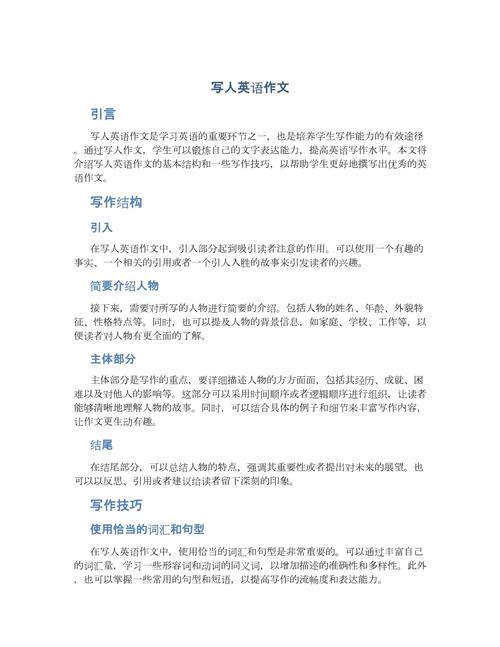
写人作文的核心是“以事显人”,即通过具体事件塑造人物形象,建议采用“总-分-总”结构,开头简要介绍人物及总体印象,中间通过2-3个具体事例展开,结尾总结人物品质或对“我”的影响。
开篇:引入人物,点明主旨
开头需简洁明了,说明人物身份(如“my grandmother”“my English teacher”)以及最核心的特质(如“kindness”“wisdom”)。
Among all the people I have known, my grandmother stands out as the most influential figure in my life. A woman of simple tastes but immense strength, she has taught me the true meaning of resilience and love through her actions over the past 18 years.
主体:具体事例,细节支撑
主体部分是文章的灵魂,需选取1-2个典型事例,结合细节描写(如人物的语言、动作、神态)展现性格,每个事例可独立成段,段落结构为“事件描述+细节刻画+品质总结”。
事例选择技巧:
- 真实性:选择亲身经历或观察到的细节,避免虚构;
- 典型性:能集中体现人物核心品质(如“乐于助人”“坚韧不拔”);
- 具体性:避免空泛评价(如“她很善良”),而是通过“她每天凌晨为邻居送早餐”等场景体现。
示例段落(描述奶奶的坚韧):
I vividly recall the winter when my grandfather fell ill, and my grandmother had to take care of him alone while managing the small grocery store below our apartment. Despite the freezing temperatures, she would wake up at 4 a.m. to prepare herbal soup for him, then head to the store to open at 6 a.m. Her hands, once soft and delicate, were now chapped from washing dishes in icy water, yet she never complained. One evening, I found her sitting beside my grandfather’s bed, holding his hand and whispering an old folk song. When she noticed me, she smiled and said, “Difficult times are like seasons—they pass, but love remains.” This moment taught me that resilience is not about avoiding hardship, but about facing it with courage.
升华主题,表达影响
结尾需呼应开头,总结人物品质对“我”的长期影响,或表达对人物的敬佩与感激。
Today, as I face challenges in my studies and life, I often hear my grandmother’s voice in my mind, reminding me to stay strong and compassionate. She may not have achieved grand things in the eyes of the world, but to me, she is a hero whose love and wisdom have shaped the person I am becoming.
常用词汇与句型
描述人物性格
- 积极品质:kind-hearted (善良的), wise (智慧的), resilient (坚韧的), compassionate (有同情心的), diligent (勤奋的), optimistic (乐观的), patient (耐心的), generous (慷慨的)。
- 例句:She is known for her compassionate nature, always offering help to those in need.
事件描写
- 动作描写:She bent down to pick up the fallen groceries, her hands trembling slightly but her smile unwavering.
- 语言描写:“Don’t worry,” she said gently, “we’ll figure it out together.”
- 心理描写:Touched by her words, I felt a surge of warmth and gratitude.
影响与感悟
- Her example has inspired me to...
- I will always cherish the lessons she taught me.
- She has left an indelible mark on my heart.
范文示例(约1141字)
Among all the people who have shaped my life, my maternal grandmother, Li Lan, is undoubtedly the most unforgettable figure. At 78 years old, she is a woman of short stature with silver hair always tied in a neat bun, and eyes that twinkle with both mischief and wisdom. Despite her advanced age, she remains active in her community, dedicated to her family, and full of life lessons that she imparts not through lectures, but through her daily actions. My grandmother’s greatest qualities—her selflessness, resilience, and unwavering optimism—have left an indelible mark on me, teaching me how to live a meaningful life.
One of the most vivid memories I have of my grandmother is her dedication to helping others, even when it meant putting her own needs aside. When I was ten, our neighborhood was hit by a severe flood that destroyed many ground-floor homes. My grandmother’s house, though elevated, was not spared—the basement, where she stored preserved vegetables and homemade pickles for the winter, was completely submerged. Instead of panicking, she immediately organized a community kitchen in our backyard. Using a portable stove she had saved for emergencies, she began cooking large pots of porridge and stir-fried vegetables, distributing food to families who had lost their kitchens. I remember watching her tirelessly chop vegetables, her sleeves rolled up to her elbows, her face glistening with sweat but her expression calm and determined. When I asked her why she was helping others when her own supplies were ruined, she replied, “Food can be grown again, but kindness once lost is hard to regain.” This act of selflessness taught me that true generosity lies in giving without expecting anything in return.
Another defining trait of my grandmother is her resilience in the face of adversity. Five years ago, she was diagnosed with severe arthritis, which made it difficult for her to walk or even hold a pen. The doctors warned her that she might eventually need a wheelchair, but my grandmother refused to let the disease define her. Instead, she adapted: she started practicing Tai Chi every morning in the park, which helped reduce her pain, and she learned to use voice-to-text software to continue her hobby of writing poetry. Last year, she even self-published a collection of her poems, titled Whispers of the Heart, which chronicles her struggles and triumphs. At the book launch, she stood on stage, her voice steady as she read a poem about “finding strength in weakness.” The audience, moved to tears, gave her a standing ovation. This experience showed me that resilience is not about avoiding hardship, but about refusing to be defeated by it. My grandmother’s ability to adapt and find joy in small moments—like the taste of fresh tea or the sound of children playing—has inspired me to face life’s challenges with a positive attitude.
Beyond her selflessness and resilience, my grandmother is also a master of storytelling, using tales from her past to impart wisdom. Growing up, I would sit beside her on the porch swing as she recounted stories of her childhood in a rural village. She told me how she walked five kilometers to school every day, carrying a sack of sweet potatoes for lunch, or how she traded her only doll for a set of math textbooks because she believed education was the key to freedom. These stories were not just entertaining; they were lessons in perseverance and the value of education. When I struggled with my studies as a teenager, I would think of my grandmother walking those dusty roads, and I would remind myself that temporary difficulties were nothing compared to the long-term rewards of hard work. Her stories have become a source of motivation for me, pushing me to pursue my goals with determination.
In conclusion, my grandmother is more than just a family member—she is my role model and my inspiration. Her selflessness has taught me to care for others, her resilience has shown me how to overcome challenges, and her storytelling has instilled in me a love for learning and life. As I grow older, I realize that the greatest gift she has given me is not material, but the wisdom to live a life of purpose and kindness. I only hope that one day, I can be as strong and compassionate as she is, and pass on her lessons to future generations.
相关问答FAQs
Q1: 雅思写人作文中,如何避免事例过于笼统?
A1: 避免笼统的关键在于“具体化”和“细节化”,选择亲身经历或观察到的真实事件,而非虚构的“完美事例”,在描述事件时,加入五感细节(如视觉、听觉、触觉)和具体动作,与其说“她很努力”,不如描述“她每天凌晨5点起床,在台灯下批改作业,红笔在纸上划过的沙沙声在寂静的夜里格外清晰”,引用人物的原话(如直接引语)也能增强真实感和感染力,让事例更生动。
Q2: 写人作文的语言是否需要华丽辞藻?
A2: 雅思写作更注重“清晰、准确、有逻辑”的表达,而非单纯追求华丽辞藻,过度使用复杂词汇或生僻句式可能导致表达不自然,甚至出现语法错误,建议以“简洁有力”为原则,用准确的词汇和多样的句型(如定语从句、状语从句、倒装句等)展现语言能力,描述人物性格时,可用“Despite her gentle appearance, she possesses incredible inner strength”替代“She is very strong but looks gentle”,既简洁又体现句型变化,核心是通过自然流畅的语言让读者感受到人物的真实形象,而非堆砌辞藻。